We're not going to put a number on this page, because what you pay depends on what's actually on your door, and we don't have pricing data to quote you honestly here. What we can tell you is what drives the cost. Most houses in the service area went up between 1966 and 1992, median year 1991, which means a lot of doors still run on the torsion springs that came with the house - not the beefed-up dual-spring setups builders started using later. A single spring job on that older hardware is a different job than replacing a pair on a newer door, and if the drums or bearing plate are original too, that changes things again. Across the service area, 4,430 of the 7,893 households are owner-occupied houses, and median household income sits at $65,321 - which is roughly where most of our repair-versus-replace conversations land, somewhere between "fix the spring" and "the whole system is original, let's talk about doing it right." Ask for a number over the phone before anyone comes out. If a shop won't give you a range without seeing the door, that's reasonable too - springs vary more than people expect.
When Waiting Is Fine
Not every broken spring is a same-day call. If your door has two springs and only one let go, the opener can usually still lift the door a few times before it strains the motor - enough to get a car out and call us on your schedule instead of ours. If you're down to one car in that bay and it's already parked outside, there's even less pressure. What changes the math is cold. On a hard-freeze morning, steel that's already fatigued from decades of cycling is more likely to snap the second spring while you're forcing the issue, and a torsion spring letting go under load is not something you want happening while someone's hands are near the door. So: single spring, two-spring system, car already out - wait, call when it's convenient. Single spring on a one-spring door, or the door won't budge at all - that's not a waiting situation, that's a call now. The honest limit here is that we can't tell you which one you've got over the phone with full confidence; a torsion spring that looks fine can be a day from failing, and that's a judgment call we make looking at the door, not guessing at it.
What Is Going On
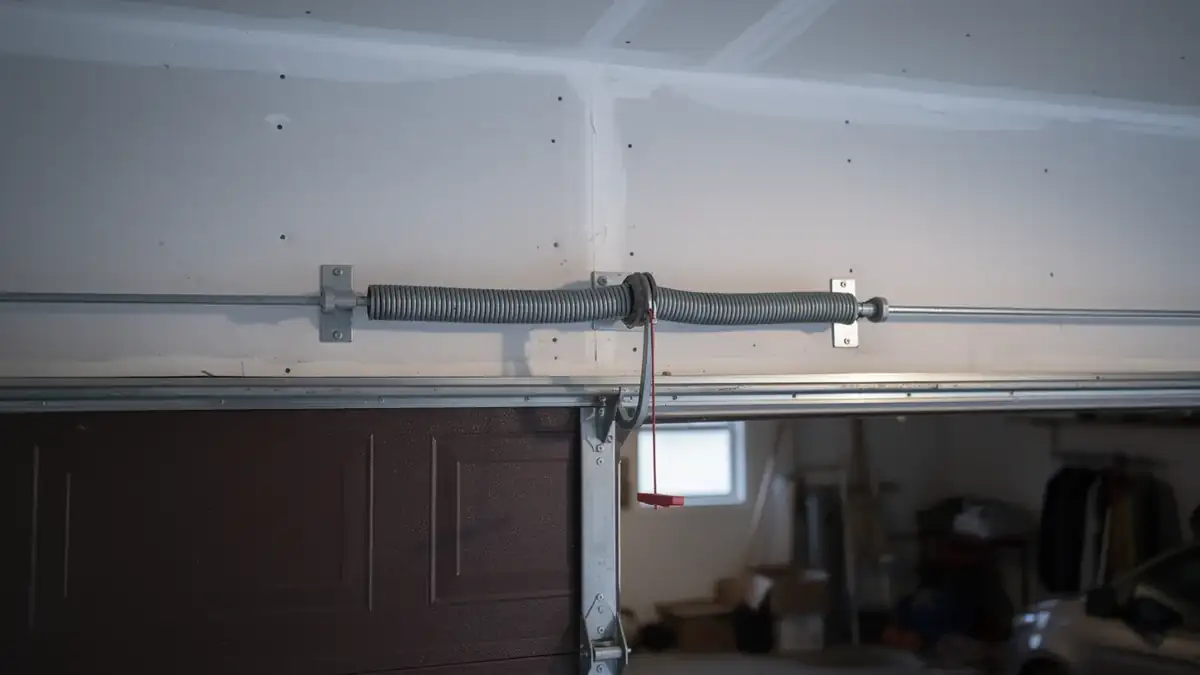
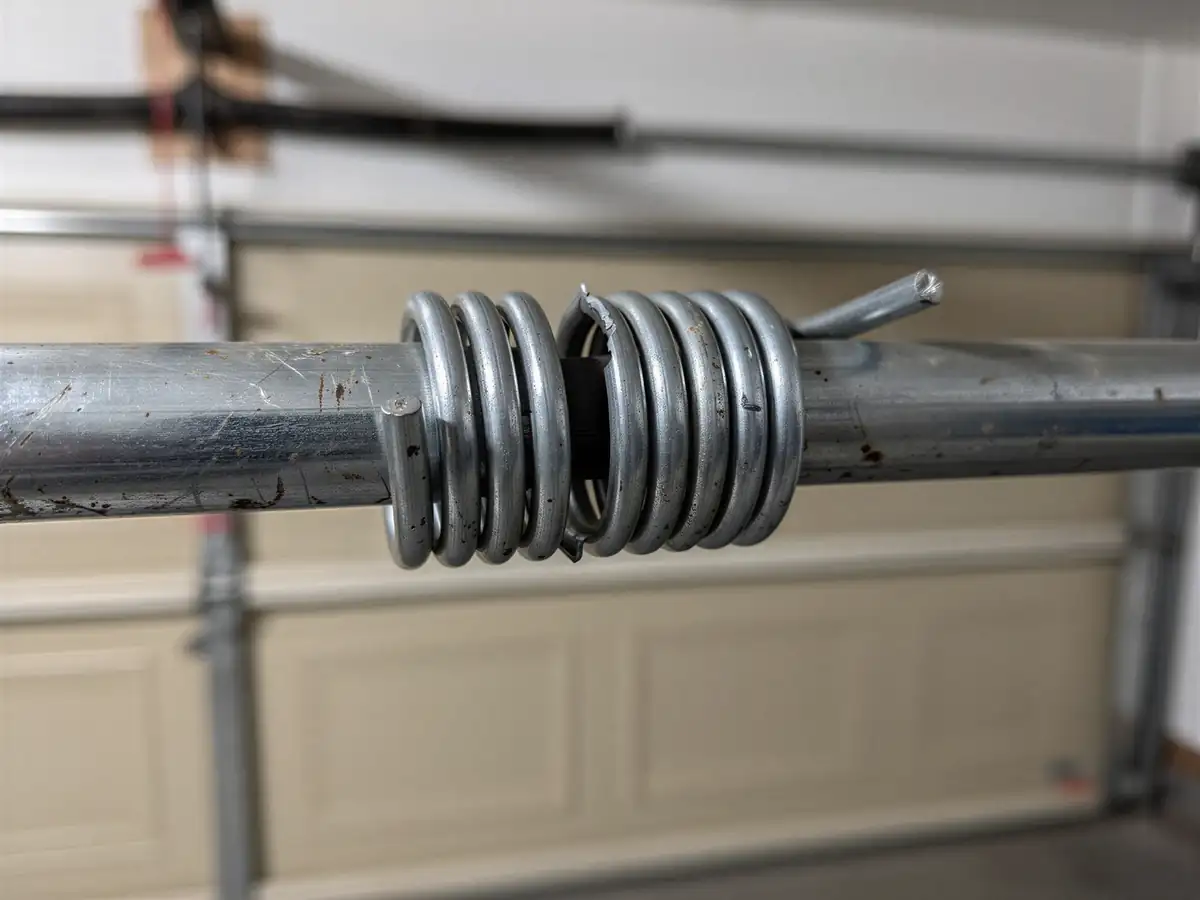
A torsion spring stores force by winding tight, then releases it in a controlled twist every time the door opens. Steel does that for a long time, but not forever - manufacturers rate springs in cycles, and a cycle is one full open-close. Houses in this area built between 1966 and 1992, with most of the stock dating to the 1980s and 90s across the service area's older neighborhoods, are well past the point where original springs are still within their rated life. Nobody replaced them on a schedule; they get replaced when they break. What actually breaks is usually a stress point - a nick in the coil from installation decades ago, or a spot where the wind has worn thin - and the spring fails there under normal torque, not because anything unusual happened that day. It just happens to be cold that day more often than not, because cold steel is less forgiving at the exact moment it's already near its limit. This isn't a defect in the door. It's a 30-to-50-year-old part doing what rated-life parts eventually do, on a door that was otherwise built fine for its era.
What the Weather Here Does to It
Suffolk sits in a cold-moderate climate band, which means the spring isn't dealing with deep sustained freezes most of the season, but it is cycling through repeated cold mornings and warmer afternoons. That swing matters more than steady cold would. Steel contracts when it's cold, which tightens the wind of the spring slightly and raises the stress at whatever weak point already exists in the coil. Add in grease and lubricant on older torsion hardware thickening up overnight, which makes the opener work harder to get the door moving on the first cycle of the day, and you've got the exact conditions that turn a spring that was going to fail eventually into one that fails on a specific cold morning. This is why spring failures cluster in the cold months here even though the climate isn't severe - it's not one bad freeze doing the damage, it's decades of ordinary cycling meeting a season of daily temperature swings. If your door groans or hesitates on the first open of a cold morning, that's worth paying attention to before it becomes a snapped coil.
Not always. If you've got two springs and only one broke, the door can usually still open a limited number of times safely, so you can call on your own schedule. If it's a single-spring door or the door won't move at all, treat it as urgent - cold makes an already-stressed spring more likely to let go under load.
Why do springs seem to break more in winter here?
Suffolk's cold-moderate climate means repeated freeze-thaw swings rather than deep sustained cold, and that cycling stresses a spring that's already near the end of its rated life. Combined with thicker lubricant on older hardware, cold mornings are when a weak spring tends to finally go.
My house was built in the 1980s - does that matter?
Yes. Most of the service area's housing dates to between 1966 and 1992, median 1991, and a lot of those doors still run original torsion springs that are well past their rated cycle count. Age of the house is a decent proxy for age of the hardware.
Can you tell me a price over the phone?
We can give you a range once we know whether it's one spring or two, torsion or extension, and whether the drums and bearings are original. We don't have a flat number to quote blind, and we'd rather tell you that than guess.
Ready to get your garage door sorted?
Tell us what it’s doing and where you are in Suffolk - we’ll take it from there.